Any links on this page that lead to products on Amazon and other companies may be affiliate links and we earn a commission if you make a qualifying purchase. Thanks in advance for your support!
Could there be secret goings-on deep below the sleepy town of Corsham in Wiltshire, clustered within a hidden network of government tunnels 30 metres below ground and stretching for 35 acres just a few miles east of Bath?
And is the Corsham area the UK’s equivalent to the American “Area 51”, perhaps linked to secret biological warfare research occurring to the east at Porton Down, or even tied up the famous GCHQ “doughnut-shaped” intelligence monitoring centre located in Cheltenham, not too far away to the north?
With Unidentified Flying Objects (UFO’s) – now known as Unidentified Anomalous Phenomena (UAP’s) – and crop circle reports still focussed on the nearby Salisbury Plain and the MOD Boscombe Down test flight facility to the east, conspiracy theories can abound. Add in the former RAF Rudloe Manor UFO investigation centre at Corsham, a cocktail of mystery could be conjured up.
The truth to this mystery is most likely much more mundane. Current MOD and secure private companies are indeed making use of the once secret underground bunkers at the Corsham site. But its history as a former Cold War central government bunker and the current MOD activity in the local Wiltshire area is a fascinating topic to explore.
Nevada’s “Area 51”
Can we really compare Corsham to the US “Area 51”? Many would argue that if the USA has a secret area full of mysterious government-run activity then why can’t the UK.
Beloved of Hollywood movies and popularised by the FBI’s Fox Mulder and Dana Scully’s “X-files” team from the TV series, the Groom Lake Test and Training Range in southern Nevada was home to the CIA’s top-secret U2 and SR71 spy-plane development testing. This area still carries on providing secret flight research activity. Mystery spy-planes such as the so-called hypersonic “Aurora” craft are still being speculated on as possibly occurring in Area 51. Certainly, the strange looking Lockheed F-117 Nighthawk “stealth” attack aircraft that were tested at Groom Lake, together with the bizarre wing-shaped Northrop B2 Spirit bomber, plus Russian aircraft that are also evaluated at this secret facility, stoke the imaginations of many.
Because of its secretive character and the lack of open access to its flight research activity, American conspiracy theorists provide endless tweets and on-line videos, claiming that the DoD, CIA and NSA have amongst other things been reverse-engineering crashed UFO’s there and even keep surviving intelligent aliens locked-up deep underground.
The most likely truth of course is that the US authorities do not like the attention and potential security breeches that might occur if the public had easy access to Groom Lake. Officially it is known as “Horney Airport”. Testing top secret aircraft often creates strange night-time lights in the sky and military police activity – resulting UFO reports and obscure press denials are inevitable, but it is all fodder for conspiracy fans.
What are Corsham’s secrets?
So, what of Corsham and its reputation for secret bunkers, public surveillance and regular MoD police patrols?
Part of the conspiracy “atmosphere” stems from this area of Wiltshire being at the western end of a concentration of military sites and activity. Bases such as RAF Brize Norton, MOD Lyneham, the AAC Middle Wallop and USAF Fairford provide multiple aircraft taking off and landing. Practicing low level helicopter flying across Salisbury Plain is a regular feature from Middle Wallop and this military activity all contributes to a host of UFO/UAP reports. Over the decades UFO enthusiasts, particularly from the mid 1960’s, were inspired by the famous “fiery cross” reports from night-time police patrols around Warminster – these turned out to be the RAF practicing high-level night refuelling exercises over the Plain …… floodlighting was employed for this at 30,000 ft, hence the “cross” appearance effect.
Ironically an MOD UFO investigation centre did once exist at Corsham during the 1950’s, taking space at the former RAF Rudloe Manor facility nearby. Release of this information at the National Archives stirred the imagination of Corsham/UFO enthusiasts. Recently deceased, Nick Pope the former MOD civil servant and subsequent author of several books about “Ufology”, was associated with a subsequent UFO investigation function as a desk officer in the MOD’s Secretariat (Air Staff) Sec (AS) 2a for three years.
Add to this all the local and somewhat mysterious late Neolithic/early Bronze age stone circles and barrows, plus the human made crop-circle mania that occurs every late summer and the onset of video-post/website culture, so a fertile atmosphere of hidden Corsham mysteries abounds.
In fact, following its early days from the 1930’s as a huge military Central Ammunition Depot (CAD) and subsequently providing the nation with a 1950-80’s Cold War “Central Government War HQ” (CGWHQ), Corsham does still have several hidden underground military-related centres.
It is no secret that there are three key but very restricted facilities operating at Corsham’s former Spring Quarry site, just south of the famous Box Tunnel railway line between London and Bath as constructed by Brunel for the Great West Railway from 1834.
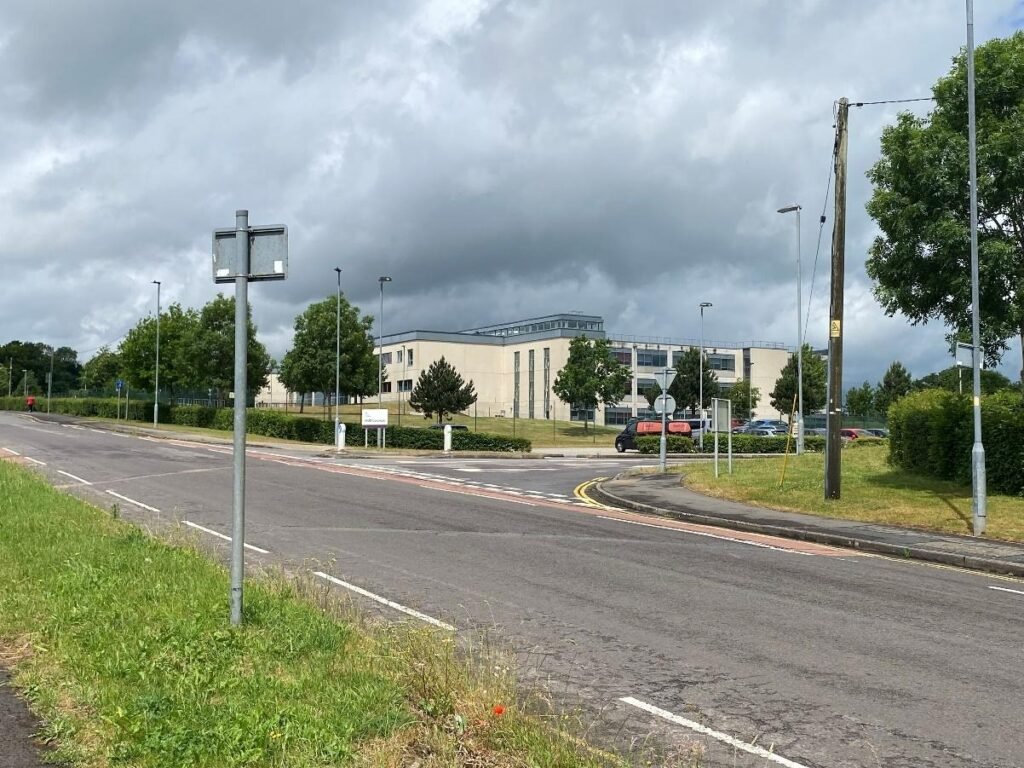
These are:
- MOD Corsham – containing the UK’s Global Operations Security Control Centre (GOSCC), the Joint Security Coordination Centre (JSyCC) and Defence Digital, this £690m project was completed in 2011.Over 2,000 staff now work there. Cyber warfare research activity occurs at the facility and apparently these functions extend above and below ground, making use of the former Cold War era bunkers built within the Bath stone quarry below the former Basil Hill Barracks. Links with GCHQ are most likely.
- Corsham Computer Centre (CCC) – a few hundred metres to the NW, this secure underground facility, close to the Box Tunnel in the former Hudswell Quarry zone, processes data for the Royal Navy’s nuclear submarine fleet, apparently including the Trident nuclear deterrent software requirements for missile targeting.
- Airbus Defence and Space (ADS) /Defence Digital – north of MOD Corsham, this private finance initiative base supports the UK’s Skynet series of secure military satellite systems, acting as a control centre and operations facility.
The location also possesses numerous datacentre buildings in the Ark business park nearby, some privately occupied, together with UK army Signals Regiment communications centres and training facilities.
All of this area sits on top of the 3,000-acre wide quarries, dug 100 ft under the surface in the 19th century for its prized “Bath stone” oolite limestone. Like the famous Chilmark quarries of Wiltshire to the east that were used to build Salisbury Cathedral, Corsham stone was applied extensively across the nation for major stone buildings and cathedrals.
To understand why the military and the UK government still make use of Corsham, one has to appreciate the history and scale of the former CGWHQ Cold War “underground city” that was standing by to protect the nation’s government.
The “Burlington” bunker
Central to the Corsham secret underground facilities story is the development of the subterranean CGWHQ. This was mainly known as “Burlington”,though it was also called at various times “Stockwell”, “Subterfuge”, “Turnstile”, “Chanticleer”, “Peripheral” and simply “Site 3”.It acted as a protected “last resort” central seat of government for the Cabinet, up to 4,000 civil servants, military leaders and, possibly, the Royal Family.
The Burlington bunker approach would eventually be replaced by “Python”, a more flexible government survival plan that attempted to take account of the emerging and much more accurate Soviet ICBMs of the late 1960’s.Declassified by the UK government in 2004, in fact the CGWHQ location had been speculated on in author Peter Laurie’s 1979 book “Beneath the City Streets” and also, called “Hawthorn”, it was described by Duncan Campbell in his 1982 book “War Plan UK “.
In terms of its development history, in1934 the entire Tunnel Quay underground stone quarry at Corsham was purchased by the War Office. This became a massive ammunition store for all UK land forces through the 1930’s and into the 1939-45 WW2 years, deep below the surface and well protected from bomber threats of the time. Links with the adjoining Box railway tunnel were put in place.
Come the WW2 years, by 1942 Minister of Aircraft Production Lord Beaverbrook wanted aircraft factories positioned underground, immune from German bombing. The Bristol Aeroplane Co. were tasked with producing the Centaurus aero engine at Corsham, with over 2.2m sq ft of space available. With up to 20,000 workers using the facility, extensive access shafts, two tube-style Otis escalators in inclined shafts, four passenger lifts and five heavy duty lifts were installed. Workshops, canteens for 6,000 at a sitting, coal generators and surface housing were built. By the end of the war in 1945 over £20m had been spent, though apparently with little aircraft production resulting from the investment.
Post war changes – the CGWHQ
Come the nuclear age, in 1954 the UK government’s “Crossbow Committee” advised that a secret “Emergency Government HQ” was needed that could withstand a nuclear weapons attack by the Soviet Union.
By 1957 a layout was established for Corsham, with up to 1m sq ft of useable space allocated across 35 acres, providing a potential space for up to 7,700 civil servants, oil generators, a water storage lake, a massive telephone exchange eventually becoming the second largest in the UK, a BBC broadcasting studio, a bakery, 1,000 WC’s, restaurants, a bar, air condition services, passenger and heavy goods access lifts and concrete-capped air intake shafts provided.
With the RAF taking over the telecommunications required, by 1961 “Burlington” was largely complete – ironically it was just in time for the October 1962 Cuban Missile Crisis. If such a threat had led to the onset of a nuclear war, the plan was to ship 4,000 civil servants from across the UK to the bunker via 200 requisitioned buses. The Queen and others in the Royal Family may have had rooms allocated within the bunker. The War Cabinet, Chiefs of Defence Staff with their secretariats would be installed and the PM would arrive at the last minute of any crisis threat, via helicopter transfer from London. With the military heads in place, future national retaliation using the UK’s V-bomber force could be ordered from Corsham.
Intending to stay sealed-up for at least 30 days, with supplies available for a three-month war duration, the plan was that the CGWHQ would provide the survival and continuity of the UK’s central government, leading from a “Precautionary Period” of any future war through to a “Survival” stage and then on to a national “Reconstruction” phase.
Evolution of Burlington
By the mid 1960’s it was realised that more accurate and powerful Soviet ICBMs made Corsham a vulnerable target. The “Python” plan then brought in was for a more flexible dispersal of Cabinet leaders to Regional Seats of Government (RSG’s) across the nation. Allocated individual Ministers in the RSG’s would become “Commissioners” of the Crown, wielding immense power over local government and surviving citizens.
During the 1979-82 Thatcher government years, Corsham would evolve into a command nucleus for the military. By 1991 with the collapse of the Soviet Union, virtually all of the UK’s emergency wartime civil preparedness, the Royal Observer Corps (ROC), Civil Defence, the Auxiliary Fire Service (AFS) and UK Warning and Monitoring (UKWMO) activity was closed down.
Today, some of the functions of Burlington are provided by the PINDAR deep underground bunker at the MOD in Whitehall, linking to the Army Standing Joint Command HQ at Aldershot, the RAF’s Air Command at High Wycombe and HMS Warrior at Northwood where control and communications with the four Royal Navy SSBN Trident nuclear response submarines occurs. One of these SSBN’s is on permanent standing patrol at sea.
No known comprehensive government civil defence or national resilience plan effectively exists, aside perhaps from general advice from the “Resilience Directorate” in the Home Office to the public – this currently only advises stocking-up for at least three days emergency food and water supplies and ensuring smart-phones are kept charged-up in case of power cuts!
So apart from the still functioning surface and underground MOD and privately led computer, datacentre and comms facilities as described previously at Corsham, what remains to be seen from public view of this once-massive secret facility?
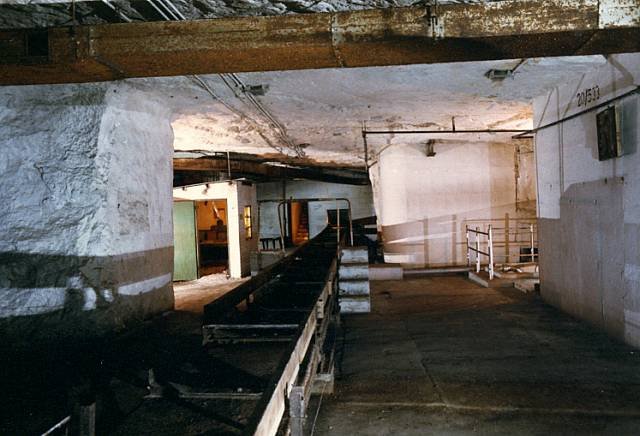
Public access to the Burlington facility is highly limited. Interestingly though, deep underground several specific portions of the complex are protected via an Historic England Grade II* listing and Monument status. These include thirty-two WW2-era murals painted by celebrated artist Olga Lehmann. Additionally, Scheduled Monument Status has been given to the PM’s operations room, the Lamson Terminus Room where pneumatic tubes sped message across the complex, the GPO Telephone Exchange and the Kitchen, Canteen, Laundry and Washroom Areas of this once self-sufficient “underground city”.
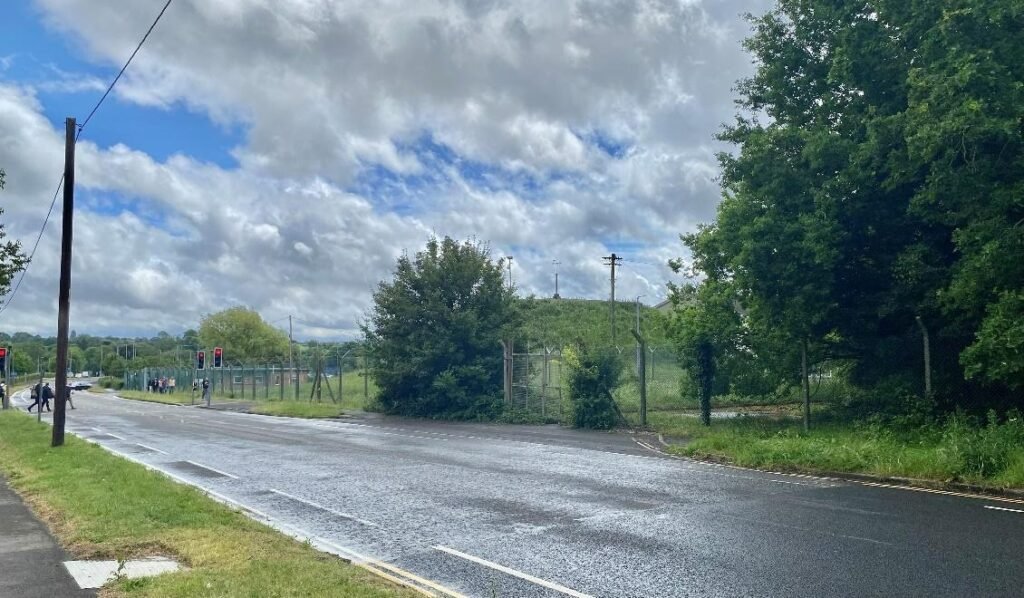
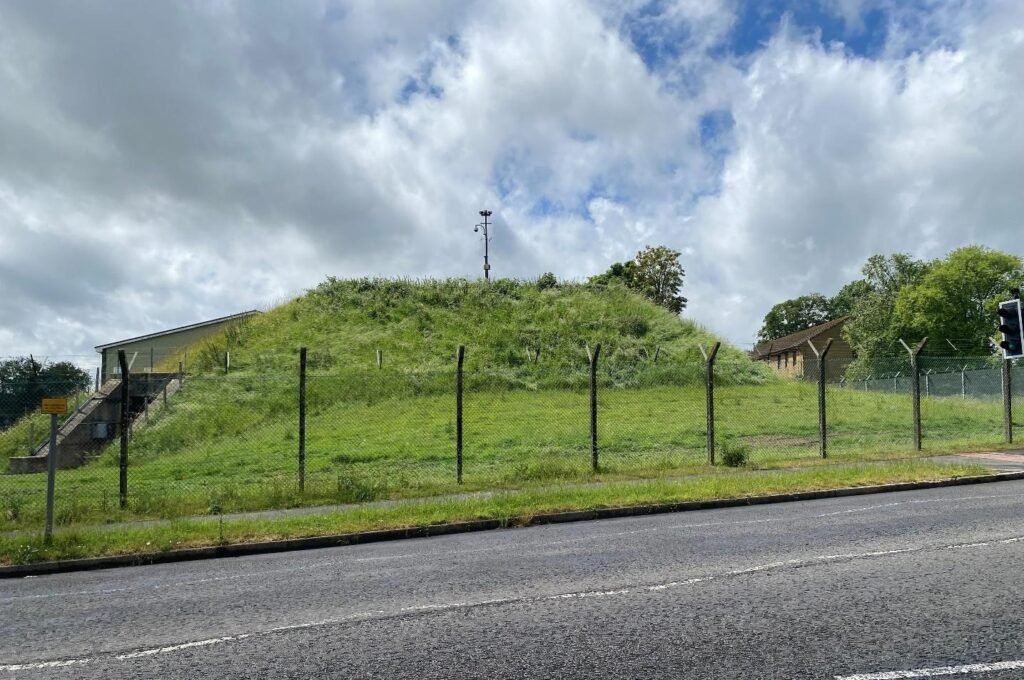
On the surface, to the south-west side of Westwells Road south of Corsham the prominent grass mounded Passenger Lift 1 (PL1) still sits close to the security fence acting as a reminder of the key role it may have once taken if the terrifying prospect of nuclear war had come close and central government staff were evacuated to the Burlington CGWHQ. Through the trees behind more recent buildings now exist, but glimpses of the massive Goods Lift 1 (GL1) that serviced Burlington can be seen. Other ventilation shaft heads and emergency escape shafts exist but are now hidden from view, interspersed amongst the newer MOD Corsham buildings.
Hardly the UK’s Area 51?
So, is Corsham really hiding more dramatic government secrets underground, a little like “Area 51” in the USA?
On the basis that conspiracies are notoriously hard to ever prove, disprove or indeed fully deny, one would have to say most likely not. Intruders have penetrated the old bunker passageways and filmed inside most areas there without any exciting discoveries, plus one would always question if over time would the signing of Official Secrets Acts really prevent dramatic revelations by former staff about strange goings-on and super-secret activity?
But Corsham and its Burlington story is still a fascinating piece of Cold War and military history – no doubt many researchers will be digging deeper into emerging information as government files about its past are released in the future.