Any links on this page that lead to products on Amazon and other companies may be affiliate links and we earn a commission if you make a qualifying purchase. Thanks in advance for your support!
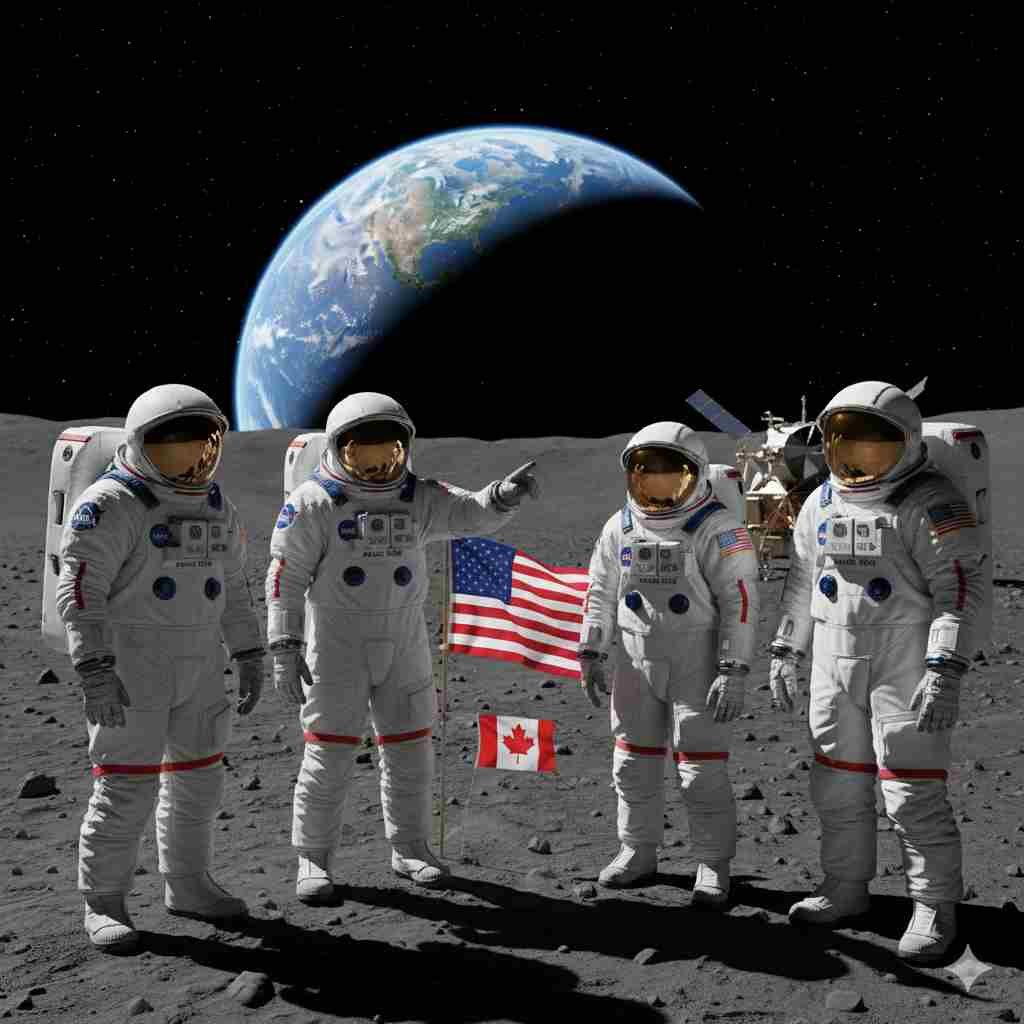
For over half a century the Moon has silently called to us, a “pearlescent orb” in the night sky, a testament to humanity’s past achievements, and a beacon for future endeavours. Now, after decades, NASA and its international partners, including ESA/Europe, Canada and Japan are poised to answer that call once more with the Artemis programme. This ambitious initiative isn’t just about planting flags; it’s about establishing a sustainable lunar presence, pushing the boundaries of space exploration and preparing for humanity’s next giant leap: Mars.
A New Era of Lunar Exploration
The Apollo program, a monumental achievement of the 20th century, saw twelve brave astronauts walk on the lunar surface between 1969 and 1972. It was a race, a Cold War victory, and an incredible display of technological prowess. But Apollo was ultimately a series of sprints.
Artemis, by contrast, is a marathon. It aims to build a long-term human presence on and around the Moon, developing technologies and procedures that will be vital for even more distant voyages.
The program’s name, Artemis, is fitting. In Greek mythology, Artemis is the twin sister of Apollo and the goddess of the Moon. This modern Artemis program honours the legacy of its predecessor while forging a new path, emphasising diversity, international collaboration, and sustainable exploration. It seeks to land the first woman and the first person of colour on the Moon, breaking new ground in representation as well as exploration.
The Artemis Architecture: Rockets, Orion, and the Gateway
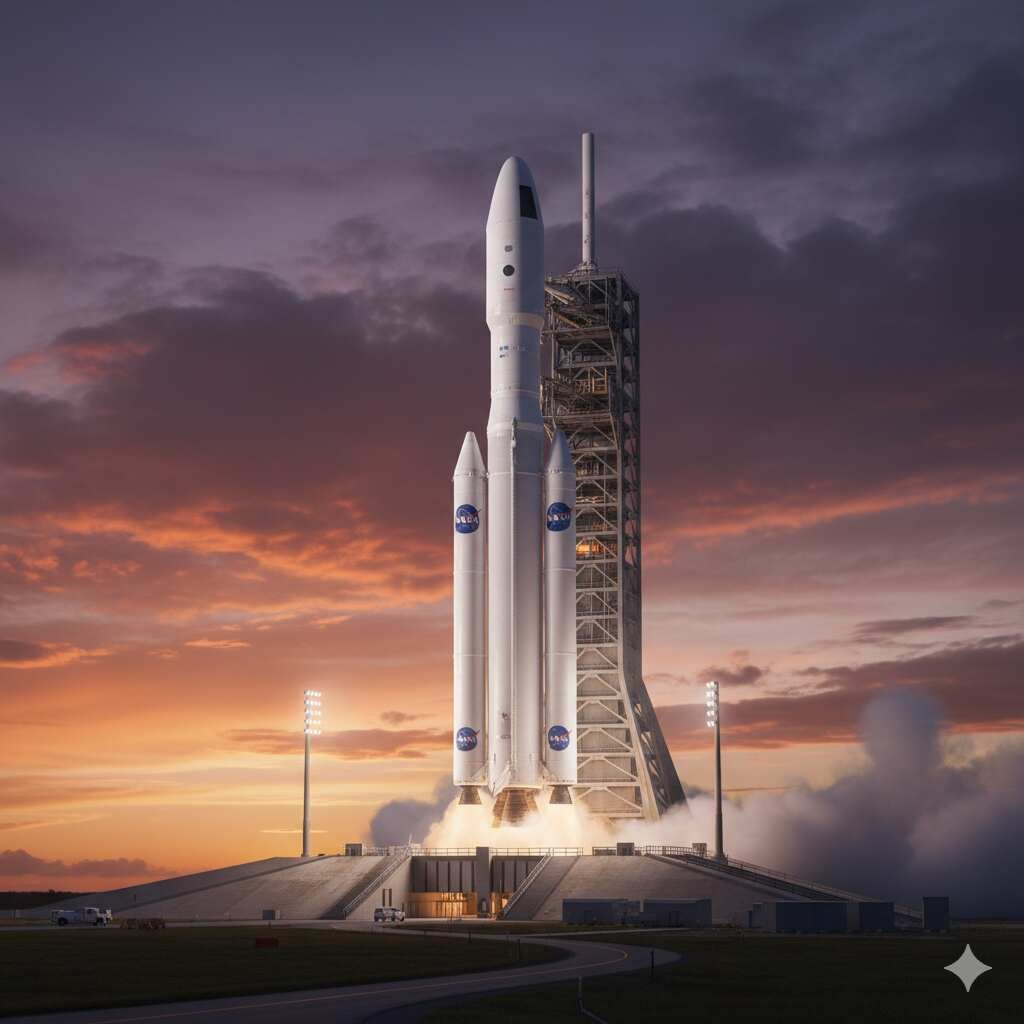
At the heart of the Artemis program is the Space Launch System (SLS), NASA’s most powerful rocket ever built. Standing taller than the Statue of Liberty, SLS is a heavy-lift launch vehicle designed to propel the four-seat Orion spacecraft and other critical hardware towards the Moon. Its immense power is necessary to send significant payloads and crew beyond Earth’s orbit.
Perched atop the SLS is the Orion spacecraft, a state-of-the-art crew capsule designed for deep-space missions. Orion is built to withstand the harsh environment of space, providing life support for astronauts for weeks at a time. It will carry the crew to lunar orbit, acting as their home away from home before they descend to the surface.
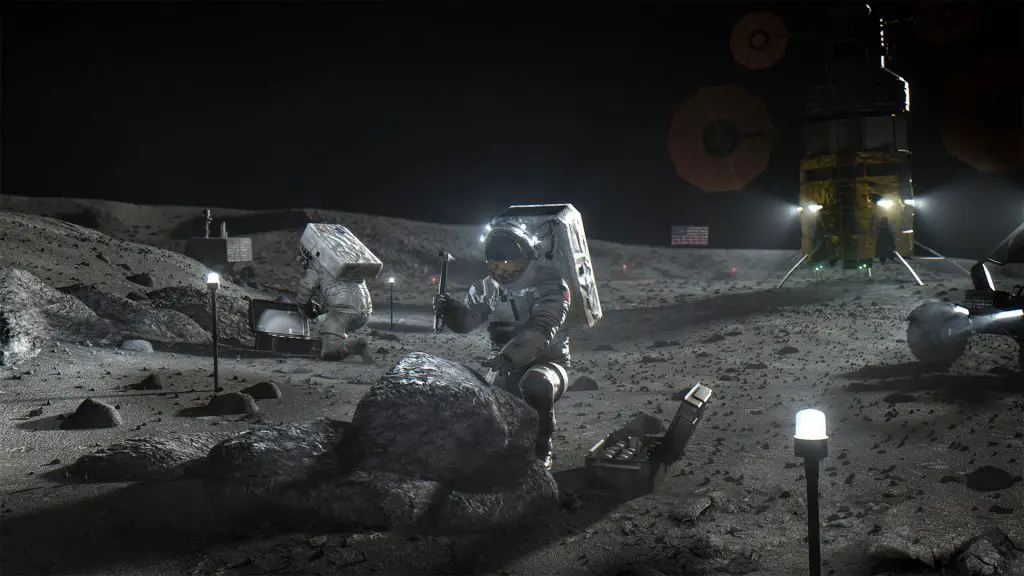
A regularly occupied Moonbase at the lunar South Pole is the goal of the Artemis. This is likely to be international in nature, with Europe’s ESA, Japan and Canada contributing elements and crews.
Complementing these is the possibility of the Lunar Gateway, a small, multi-purpose outpost that will orbit the Moon. The Gateway might serve as a science laboratory, a short-term habitation module for astronauts, and a staging point for missions to the lunar surface. It could allow for longer stays in lunar orbit, enable access to different parts of the Moon, particularly the resource-rich lunar south pole, and provide crucial support for lunar landers.
The Artemis Missions: A Stepped Approach
The Artemis program is structured as a series of progressively more complex missions:
- Artemis I (Completed): This uncrewed test flight, launched in November 2022, was a resounding success. The SLS rocket propelled the Orion spacecraft on a 25-day journey around the Moon and back, validating the rocket’s performance and testing Orion’s systems, including its critical heat shield during re-entry. It proved the fundamental architecture was sound and ready for human occupants.
- Artemis II (Completed April 2026): This was the first crewed mission of the Artemis program. Four astronauts embarked on a lunar flyby, circling the Moon but not landing. This mission tested Orion’s life support systems with humans aboard and demonstrated the crucial manoeuvres necessary for future lunar landings.
- Artemis III (2027-28) – this Earth orbital mission will test the Starship or Blue Origin HLS lunar lander spacecraft, with the Orion spacecraft docking and separating as required.
- Artemis IV (Landing from approximately 2028-29 onwards , depending on successful progress with SpaceX’s “Starship” Human Landing System (HLS) and “Blue Origin’s “Blue Moon” lander: This is the mission that will see humanity return to the lunar surface. Four astronauts will travel to lunar orbit aboard Orion, two of whom will then transfer to the HLS to descend to the Moon’s South Pole. They will spend approximately a week exploring the surface, conducting scientific experiments, and gathering samples, before returning to Orion and heading home.
- Artemis V and beyond: Future Artemis missions will focus on building a Moonbase, established for the long-term base at the lunar South Pole, and conducting extensive scientific research. These missions will also serve as proving grounds for technologies and operational procedures vital for future human missions to Mars.
The Artemis II Crew: The Pacing Four
Four astronauts who embarked on the Artemis II mission. This diverse and experienced crew represents the best of human exploration:
- Reid Wiseman (Commander): A seasoned Navy pilot and former International Space Station (ISS) commander, Wiseman brings extensive leadership and spaceflight experience.
- Victor Glover (Pilot): A Navy aviator and one of the first astronauts to fly on the SpaceX Crew Dragon, Glover will be the first African American to journey around the Moon.
- Christina Koch (Mission Specialist): An electrical engineer and veteran of three spacewalks, Koch holds the record for the longest single spaceflight by a woman (328 days), providing invaluable long-duration spaceflight expertise. She will be the first woman to journey around the Moon.
- Jeremy Hansen (Mission Specialist): A Canadian Space Agency (CSA) astronaut and former fighter pilot, Hansen will be the first Canadian to venture into deep space, highlighting the international collaboration at the heart of Artemis.
This “Pacing Four” crew played a pivotal role in paving the way for future lunar surface missions, rigorously testing Orion’s capabilities and pushing the boundaries of human spaceflight further than ever before.
Why the Moon’s South Pole?
Unlike the Apollo missions which landed near the lunar equator, Artemis will target the Moon’s South Pole. This region is of particular scientific interest due to the presence of permanently shadowed craters that are believed to harbor significant reserves of water ice. This ice is a crucial resource for future lunar habitation. It can be processed into potable water for drinking, breathable oxygen for life support, and hydrogen and oxygen for rocket propellant, effectively allowing future missions to “live off the land” and reduce dependence on supplies from Earth. The South Pole also offers unique geological formations and potential for studying the early solar system.
The Road to Mars
Ultimately, the Artemis program is not just about returning to the Moon; it’s about preparing for Mars. The Moon serves as a proving ground, a stepping stone where NASA and its partners can develop and refine the technologies, systems, and operational experience needed for even more ambitious deep-space missions.
By establishing a sustainable lunar presence, learning to utilise off-world resources, and understanding the long-term effects of deep-space radiation on the human body, Artemis will provide the invaluable knowledge and infrastructure required to eventually send humans to the Red Planet.
The challenges are immense, but the rewards—the expansion of human knowledge, the inspiration of future generations, and the ultimate triumph of exploration—are immeasurable.
Conclusion
The Artemis program is a testament to humanity’s enduring spirit of exploration. It represents a bold new chapter in spaceflight, one that promises not just a return to the Moon, but a sustained presence, groundbreaking scientific discovery, and the vital steps towards sending humans to Mars. With the SLS and Orion at its core, the international collaboration of the Moonbase, and the courageous astronauts of the Artemis II crew leading the way, humanity is once again reaching for the stars, propelled by innovation, determination, and the timeless call of the cosmos.
Images generated by Gemini